
Homes
Built for
Coastal Conditions
New Construction in Morehead City for coastal lots requiring moisture-resistant framing and flood-zone compliance
Davies Contracting builds residential and commercial structures from the ground up on Crystal Coast coastal lots where moisture-resistant framing decisions must be made before the first board is set. Carteret County coastal lots face flood-zone requirements, high water tables, and hurricane wind-load codes that shape the framing plan from day one. You work with a local contractor who handles permit coordination with Carteret County in-house to prevent schedule-killing delays that traveling crews often trigger when they attempt to navigate unfamiliar permitting systems.
Ground-up construction on coastal lots means selecting lumber grades, fastener types, and foundation systems that account for saltwater exposure, storm surge potential, and saturated soil conditions that vary block by block across Morehead City, Beaufort, and Pine Knoll Shores. The framing system and anchor hardware are specified to meet hurricane wind-load codes before material orders are placed.
Schedule a project consultation to review your coastal lot constraints and permitting timeline.
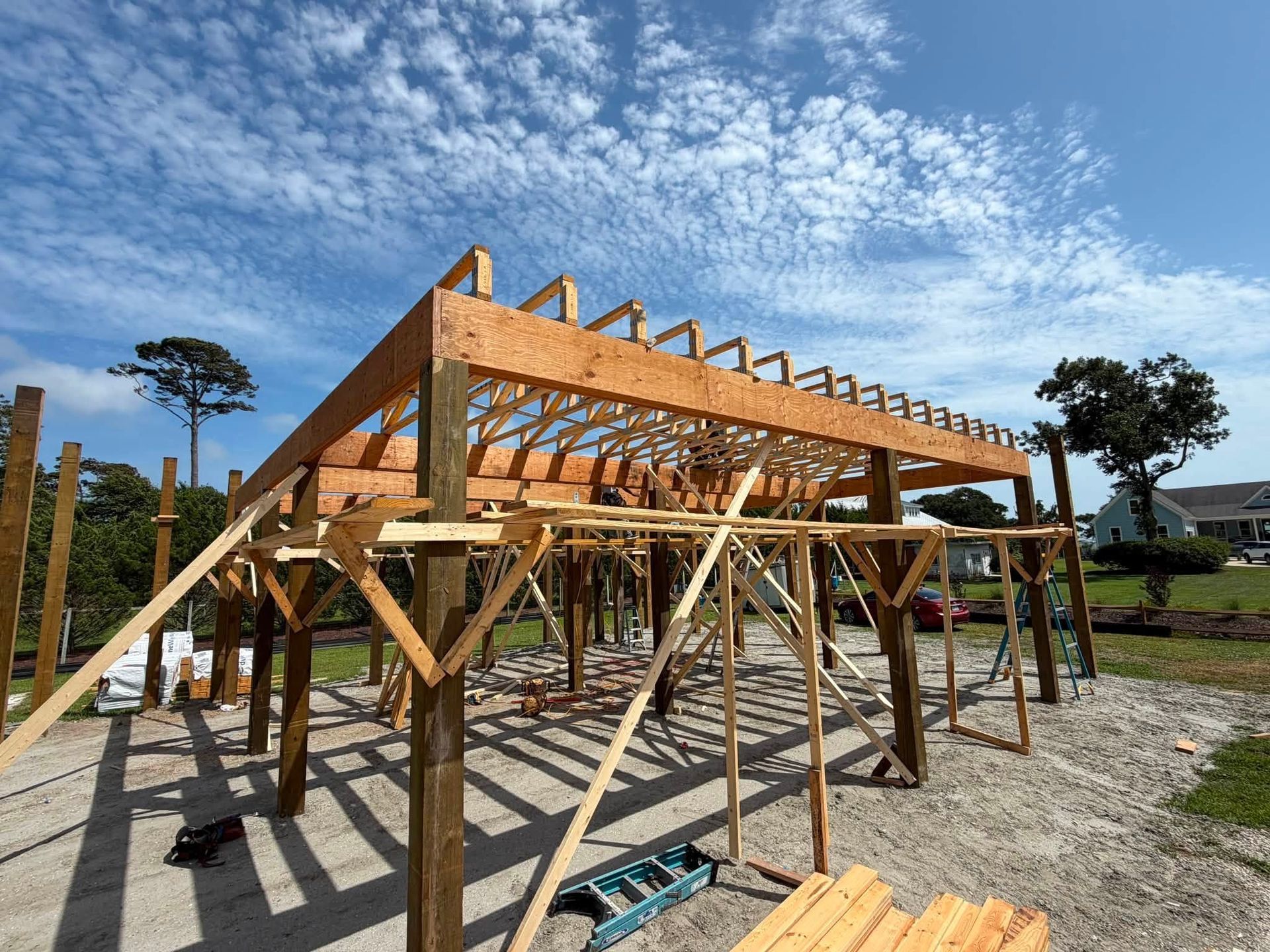
What Proper Coastal Construction Requires
Coastal new construction follows a sequence that integrates flood-zone elevation requirements, moisture-resistant lumber selection, and structural anchoring into the initial site plan. Your foundation system is designed around the specific water table depth and soil bearing capacity documented in the geotechnical report, not guessed at during excavation.
Once framing is complete, you see a structure anchored to meet hurricane wind ratings, built with treated lumber where moisture contact is expected, and elevated to the base flood elevation required by Carteret County code. The roof sheathing is fastened to resist uplift forces documented in coastal wind-load tables, and exterior sheathing is installed with drainage planes that prevent trapped moisture in wall cavities.
Davies Contracting manages the full process from permit application through certificate of occupancy, coordinating inspections at the foundation pour, framing stage, rough-in, and final walkthrough. Structural changes discovered during construction are evaluated for code compliance before work proceeds, and change orders are documented with updated cost and timeline impacts before you approve them.
What Property Owners Usually Ask
These questions come up regularly when property owners plan new construction projects on Crystal Coast lots.
What happens if the soil conditions are worse than expected?
The foundation system is adjusted based on the geotechnical report findings, which may require deeper footings, additional reinforcement, or a different foundation type entirely, and those changes are presented with updated cost projections before excavation begins.
How long does the permitting process take in Carteret County?
Permit timelines vary based on project complexity and whether flood-zone variances are required, but in-house coordination typically moves residential permits through review in four to six weeks when plans are submitted complete with all required engineering documents and site surveys.
What type of framing lumber is used in coastal construction?
Pressure-treated lumber rated for ground contact is used for sill plates and any framing members within eighteen inches of grade or exposed to weather, while standard framing lumber is used for interior walls and upper-floor framing where moisture exposure is controlled.
How do hurricane wind-load codes affect the framing plan?
Coastal structures in Morehead City require engineered roof-to-wall connections, increased fastener schedules for sheathing, and Simpson Strong-Tie or equivalent hardware at every structural connection point to resist the uplift and lateral forces documented in the local wind-load tables.
What is included in the scope from groundbreak to certificate of occupancy?
The contract covers site preparation, foundation, framing, rough-in trades, exterior envelope, interior finish, and final inspections, with each phase scheduled in sequence and inspected before the next phase begins.
Davies Contracting brings Carteret County permitting knowledge and coastal soil expertise to every ground-up build along the Crystal Coast. Request a site evaluation to review your lot constraints and construction timeline.